>|<
0%
BOOT SEQUENCE · A–01
>|<
ERR

Something did not arrive.


TELL ME
A D R L
AFONSO LOPES
SCROLL
01

ABOUT

SEC—01

Networks, radio links and security — the infrastructure everyone uses and nobody sees, from the cable in the wall to the packet on the wire.

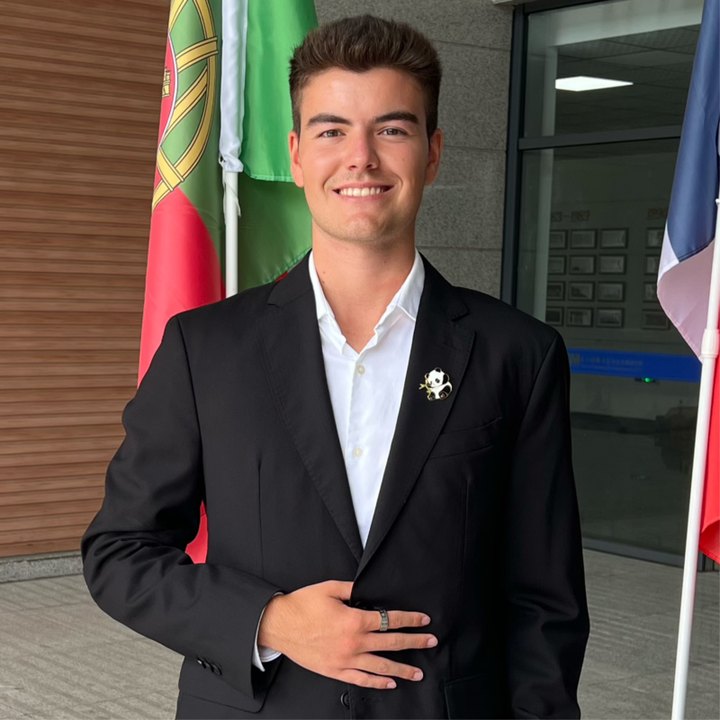
Afonso Lopes

Afonso Lopes

AGE
21
BASED
LISBON · PORTUGAL
FIELD
TELECOMMUNICATIONS & COMPUTER ENGINEERING
NOW
MSc AT ISCTE · MINOR IN CYBERSECURITY
ETHOS

I studied Telecommunications and Computer Engineering at ISCTE — I was also admitted to IST for Electrical and Computer Engineering, and chose to stay — and went straight into the MSc with a minor in Cybersecurity. What I enjoy most has a pattern: a home network stuck at 100 Mbps, a radio link blocked by a hill, a smart bulb talking to a server it has no business knowing. Something is not behaving the way it should, and I want to know exactly why. That is the work I am after: building networks that work, and making sure they keep working when someone tries to break them.

02

TRAJECTORY

SEC—02
2026 — 2028

MSc Telecommunications and Computer Engineering

ISCTE — INSTITUTO UNIVERSITÁRIO DE LISBOA · MINOR IN CYBERSECURITY

In progress. Alongside it, the Cisco Cybersecurity Associate (CCNA Cybersecurity) through the ISCTE Networking Academy in the second semester.

IN PROGRESS
JUL 2026

Summer School — Future AIoT

UESTC · CHENGDU, CHINA · TWO WEEKS

The only student from my degree among the five sent by ISCTE. Two weeks of international connections, a culture nothing like my own, people from all over the world and a country that beat every expectation — with robotics, AI and CPU architecture on the syllabus. And a final project that scored 98/100, the top mark of the programme.

2023 — 2026

BSc Telecommunications and Computer Engineering

ISCTE — INSTITUTO UNIVERSITÁRIO DE LISBOA

Finished at 15/20, the second-highest average of my year, and without ever sitting a resit exam — not in the degree, and not before it.

2020 — 2023

High School — Science and Technology

FINAL AVERAGE 16/20 · 17/20 IN THE FINAL YEAR
03

PROJECTS

SEC—03

WHAT I HAVE ACTUALLY BUILT

01
IN DEVELOPMENT

ML-powered threat detection & auto-quarantine for IoT — course project

ISCTE · MSc · NETWORK AND INFORMATION SYSTEMS SECURITY · ML-DRIVEN IoT SECURITY

A smart bulb can’t run an antivirus — so the gateway watches its traffic, lets three ML models judge it, and quarantines it the moment it turns.

MODELS, HEAD TO HEAD
3
ALERT → THROTTLE → QUARANTINE
3-step
WHERE IT RUNS
Edge
READ MORE ↓SHOW LESS ↑

A smart bulb can’t run an antivirus. Neither can a camera or a sensor — too little compute, almost never patched. Get one recruited into a botnet and it carries on glowing as if nothing happened. The only place it gives itself away is on the wire.

So the defence lives on the gateway. Zeek turns every device’s traffic into flows, and three models compete to call each one normal or malicious: a Random Forest trained on labelled attacks, an Isolation Forest that needs no labels at all, and an Autoencoder that only ever sees normal traffic and flags whatever it can’t reconstruct. When a device is judged compromised, nftables responds in steps — alert, throttle, quarantine — so a false positive costs a warning, not a dead camera.

Trained on IoT-23, real malware captures labelled by the same Zeek that runs on the gateway, so the models meet in production exactly the features they learned on. It picks up where Noetzold, Leithardt et al. (2026) stopped: automatic response and running at the edge were their future work. Tested in Docker with an attacker replaying IoT-23 captures — no live malware — and judged on precision, recall, F1, false positives and the number that matters most: how long from the first malicious packet to the device being cut off.

Machine LearningZeekRandom ForestIsolation ForestAutoencodernftablesDockerIoT-23
02

afonsolopes.is-a.dev

2026 · PERSONAL · THE SITE YOU ARE ON

A single hand-written HTML file on Cloudflare’s edge, with a free is-a.dev domain and a running cost of exactly zero.

HOSTING
€0
DOMAIN
€0
FILES OF CODE
1
READ MORE ↓SHOW LESS ↑

Yes, this one. A single hand-written HTML file — no framework, no bundler, no build step. The dragonfly at the top is a real 3D model rendered with three.js and redrawn as text characters by a custom shader, every frame.

It runs on Cloudflare Pages, served from Cloudflare’s global edge with HTTPS out of the box. The domain is free too: is-a.dev gives developers a subdomain through a pull request on GitHub — open it, get it reviewed, get it merged. Running cost: zero.

Under the hood: a strict Content-Security-Policy and HSTS set at the edge, Draco-compressed models decoded in WebAssembly, cookieless analytics so there’s no consent banner in your way, and a contact form that works without a backend.

Cloudflare Pagesis-a.devthree.jsWebGLGLSLCSPJavaScript
03

High-Level Enterprise Network Architecture my house :)

PERSONAL · ITED · STRUCTURED CABLING · TROUBLESHOOTING

Old phone sockets, Cat 5e in the walls and one stubborn DCC — from 100 Mbps to gigabit in every room, without pulling a single new cable.

BEFORE → AFTER
100 → 1000 Mbps
ALREADY IN THE WALLS
Cat 5e
NEW CABLES PULLED
0
READ MORE ↓SHOW LESS ↑

Every room had a wall socket nobody had touched since the landline days. Same RJ45 shape, though — so why not turn the old phone wiring into Ethernet? First test: 100 Mbps. It linked, but only two pairs were doing any work. Wired for a telephone, not for a network.

Opened the sockets: Cat 5e behind the wall, perfectly capable of gigabit — but the keystones were punched down in the wrong colour order. Re-terminated them properly. Tested again. Still 100 Mbps.

So, the ATI box. The DCC was sitting in the path, crippling every run, and there was no way to reconfigure it. I took it out of the equation: pulled the runs, crimped them myself and plugged them into a switch. Result — gigabit in every room, lower latency, and a home network that finally behaves like one.

ITEDATICat 5eKeystoneCrimpingSwitchingGigabit Ethernet
04

Designing a Mafra ↔ Monsanto microwave link — course project

ISCTE · THIRD YEAR · TELECOMMUNICATIONS SYSTEMS PROJECT · DIGITAL MICROWAVE LINK

A 155 Mbit/s radio link carrying 64 TV channels from Mafra to Monsanto — around a hill, within ITU-R limits, and costed over 25 years.

STM-1 PAYLOAD
155 Mbit/s
VIDEO CHANNELS
64
COSTED LIFETIME
25 yrs
READ MORE ↓SHOW LESS ↑

A design study for a course: 155 Mbit/s and 64 TV channels between two digital terrestrial television stations — from Mafra to Monsanto, in Lisbon — with no cable in between. Just antennas, a lot of terrain, and the ITU-R watching every decibel.

The straight line was the first casualty: plotted over a flat and then a curved Earth, the hills cut into the first Fresnel ellipsoid and the direct link was dead on paper. So the path bends through a repeater, placed where the terrain allows it — and from there it’s link budgets, the optimum frequency and modulation, fade margins, diversity, reliability against ITU-R objectives, and the geometry to aim it all.

Then the part most engineering projects skip: what it actually costs. Every mast, shelter, antenna and waveguide specified and priced, ANACOM licence forms filled in, and 25 years of operation modelled down to the average daily cost of a single video channel — plus a look at energy and environmental impact, because a link that runs for 25 years should earn its footprint.

Microwave LinksFresnel ZonesLink BudgetITU-RDiversityRepeatersCost EngineeringANACOM
05

A three-site network for a fictional company — course project

ISCTE · SECOND YEAR · COMPUTER NETWORKS FUNDAMENTALS · CISCO PACKET TRACER

Three offices, one /23, VLANs, Spanning Tree and RIPv2 — then cut the fibre and watch the traffic find its own way over DSL.

SITES
3
ADDRESS BLOCK
/23
ROUTING
Static → RIPv2
READ MORE ↓SHOW LESS ↑

The brief: Xpto, Lda, a made-up company with three offices — Lisbon, Porto and Ponta Delgada, in the middle of the Atlantic — and a single /23 to share between them. Designed from the address plan up: a VLAN per department per site, Wi-Fi on its own segment, a four-switch mesh in Lisbon kept loop-free by Spanning Tree, and routers tying it together over 802.1Q sub-interfaces.

Lisbon and Porto talk over fibre with DSL as backup; the Azores hang off DSL. Routing started static — aggregated, smallest tables possible — then moved to RIPv2. The best test: cut the fibre and watch traffic reroute over DSL on its own. One DHCP server addresses every site through relay agents, an internal web server answers from anywhere in the company, and every layer was then taken apart frame by frame — ARP, VLAN tags, 802.11, DHCP, RIP — to prove it did what the diagram promised.

Packet TracerVLANs802.1QSTPVLSMRIPv2DHCP RelayWi-Fi
04

FUTURE AIoT

SEC—04

SUMMER SCHOOL · UESTC · CHENGDU, CHINA · 14 DAYS

Fourteen days at the University of Electronic Science and Technology of China, as the only student from my degree among the five ISCTE sent.

The programme ran from telecommunications and networks through CPU architecture into robotics — a humanoid navigating on computer vision, a robot driven by brainwaves — and generative AI. For the final project my team designed and built a CPU from scratch and then put a pattern-recognition system on top of it. It scored 98/100, the highest mark of any team on the programme, and I came away with a 4.0 GPA. I turned 21 somewhere in the middle of it.

← DRAG TO EXPLORE →
05

SIGNAL

SEC—05
PARTICIPANT

World’s largest programming lesson

GUINNESS WORLD RECORD · MAGMA

A record-holding class, and a reminder that scale is its own engineering problem — even for a lesson.

MENTOR

Núcleo de Estudantes de Tecnologia

NET · ISCTE · SEP 2024 — JAN 2026

Technical mentoring inside the technology society: one mentee, working through their projects and the reasoning behind them rather than handing over answers.

MENTOR

INISCTE

ISCTE · SEP 2024 — JAN 2026 · CERTIFICATE IN BUDDY MENTORING

Supporting new students through the transition into the degree — structured guidance and one-to-one check-ins, through the first-year subjects that decide whether people stay.

AMBASSADOR

Quidgest

DEC 2024 — JUN 2025 · SEVEN MONTHS

Representing the company on campus and standing between it and the student body.

STAFF

FISTA

LISBON · MAR 2026

Ran the logistics for the IT Speed Talks sessions, and the parking.

06

DOMAINS

SEC—06
LINK · LIVE
06.1

NETWORKS

Routing and switching, addressing, the protocol stack from the wire upward.

06.2

CYBERSECURITY

The MSc minor, and CCNA Cybersecurity next. Where trust is assumed, and what it costs when the assumption is wrong.

06.3

TELECOM

Signals, modulation, transmission. The physical truth under every abstraction above it.

06.4

CLOUD

Distributed systems and the infrastructure they actually run on, rather than the diagram of it.

06.5

AI & IoT

Artificial Intelligence in the second year, then two weeks at UESTC on where it goes next: intelligence pushed to the edge, on devices with no room to spare.

LANGUAGES

PortugueseNATIVE
EnglishFLUENT
SpanishINTERMEDIATE
FrenchBASIC
MandarinBASIC

TOOLKIT

CODE
JavaPythonC / C++PHPSQLBashHTMLCSS
NETWORK & SECURITY
Cisco Packet TracerWiresharkTCP/IPRouting & SwitchingStructured Cabling
SYSTEMS & DATA
LinuxWindowsVMwareMariaDBMySQLphpMyAdmin
HARDWARE & SIMULATION
CPU ArchitectureLogisimCST Studio SuiteCircuits
TOOLS
Git & GitHubIntelliJ IDEAEclipseVisual StudioMicrosoft OfficePhotoshopAfter Effects
07

CONTACT

SEC—07

OPEN TO INTERNSHIPS AND WORK IN NETWORKING AND CYBERSECURITY

WRITE
TO ME
ON
LINKEDIN
Open the contact form BSc MSc
OPEN
AFONSO LOPES — CONTACT BOARD · A–01